
Schema
Schema Theory has a concept of thinking believe that previous experience of the learner affect learning. Because in order to learn ,a learner need to be taken their prior knowledge collected to help in the interpretation of new knowledge in order to understand better. The term Schema refers to a cognitivity in the brain which is organizing informations and experiences as a group ,and it’s helpful for the new informations that are coming in .It will predict and interpret the new information in accordance with the existing structure.
Types of Schema
- Roles - The first type, role schemas help people understand the social environment with which he or she is engaged and adjust to the situation.
- Person - Not only do we develop expectations about other people based on the social role that they occupy, we develop expectations about their behavior based on their personality traits.
- Self - We also have schemas about self. Similar in the way in which we expect others to act in certain situations, we have expectations about how we should act in different situations. For example if I believe that I am outgoing and people like talking to me at parties, then I will feel obligated to change my behavior to fit this self schema.
- Events - Schemas for specific events are sometimes referred to as scripts. Much like schemas for personality traits event schemas are based on expectations of how to behave in a variety of situations.
Loftus and Palmer 1974
Objective
The aim of this study was trying to find out how information supplied after an event, influences a witness's memory for that event.
Aim
To show that the leading questions can distort eyewitness testimony according to different cues.
Experiment 1 - Procedure
- 45 American students
- Laboratory experiment with 5 conditions, only one being experienced by each students
- They were shown with 7 films of traffic accidents ranging in duration from 5 to 30 seconds random for each person
- Film participants were asked to describe what had happened as if they were eyewitnesses.
- Asked the speed of the colliding cars using different wordings (Independent Variable)
- The answer they gave, the speed, becomes the dependent variable.

Result
- Estimated speed was affected by the verb used Verb implied information about the speed, which affected the participants’ memory of the accident.
- Participants asked the “smashed” question thought the cars were going faster than those who were asked the “hit” question.
- Participants in “smashed” condition reported the highest speed estimated which was 40.8 mph, “collided” was 39.3 mph, “bumped” was 38.1 mph, “hit” was 34 mph, and “contacted” was 31.8 mph

Experiment 2 - Procedure
- 150 students in groups of 50 was shown 1 minute film of cars driving in countryside with a car crash
- The independent variable - the wording of the question asked - was done after the film
- One group was asked to estimate how fast the car was going when they smashed into each other, one was asked using the word hit, and one wasn’t asked at all.
Result
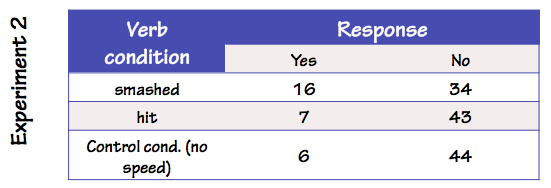
The result shows that the verb (smashed) in the question influenced and shaped their memory and were twice as likely to recall seeing broken glass.
Conclusion
- Information acquired after a certain event can affect one's memory causing inaccurate recall or reconstructive memory.
- The addition of false details to a memory of an event is referred to as confabulation.
